
|
|
|
|
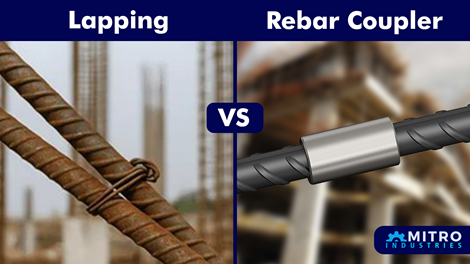
Advantages And Disadvantages Of Using A Rebar CouplerThe primary difference between a rebar coupler (mechanical splice) and lapping rebar lies in how they transfer load, leading to distinct advantages and disadvantages in reinforced concrete construction. Advantages of Couplers Superior Structural Performance: Couplers create a joint that behaves like a continuous bar, transferring the load directly through the steel, independent of the concrete’s condition or bond strength. This is crucial for seismic-resistant structures and critical joints. Reduced Congestion: They eliminate the need for the long overlap length of lapping, significantly reducing the amount of steel clustered at a splice location. Less congestion improves the flow and compaction of fresh concrete, thereby reducing voids and honeycombing. Material Savings: They eliminate the extra steel required for the overlap length, leading to significant material savings, especially with large diameter bars (typically $\ge 32\text{ mm}$), where code often prohibits lapping. Simpler Design & Faster Installation: They eliminate complex lap length calculations and can often be installed quickly with simple tools, accelerating the construction schedule. Aesthetic & Space Saving: Reduced reinforcement volume allows for smaller concrete member cross-sections, optimizing floor space, particularly in high-rise buildings. Press enter or click to view image in full size Disadvantages of Couplers Higher Initial Cost: The couplers themselves are more expensive than the extra length of rebar needed for a lap. Bar Preparation: Many coupler types (e.g., threaded) require specialized machinery and an extra step to prepare the rebar ends (e.g., cutting threads) before they can be installed. Quality Control: Proper installation is critical. Poor threading, inadequate torquing, or misalignment can compromise the joint’s strength, requiring stringent on-site inspection. Lapping Rebar (Lap Splice) Lapping is a traditional method where two reinforcing bars are placed side by side with an overlap, secured by a tie wire. Advantages of Lapping Lower Initial Cost: It’s generally the most economical method, as it only requires standard rebar and tie wire. Simplicity and Availability: It’s a straightforward process that uses standard materials and construction techniques, widely understood by site labor. No Special Equipment: It requires no specialized machinery for bar preparation or installation beyond standard bending and cutting tools. Disadvantages of Lapping Reliance on Concrete: Load transfer relies entirely on the bond strength between the overlapping bars and the surrounding concrete. If the concrete is cracked or poorly consolidated, or the lap length is insufficient, the splice’s performance is compromised. Rebar Congestion: Lapping introduces twice the amount of steel at the splice location, leading to severe reinforcement congestion in heavily loaded members (like columns or shear walls), which hinders concrete placement. Material Wastage: The significant length of overlap required by building codes for load transfer is essentially wasted material that doesn’t contribute directly to the member’s length. Unsuitability for Large Bars: Most building codes either prohibit or heavily restrict the use of lap splices for very large diameter bars (e.g., above $32\text{ mm}$ to $36\text{ mm}$) due to the excessive lap length required. Why are rebar couplers considered great in terms of safety and durability? Rebar couplers are generally considered better than traditional lap splicing in terms of safety and durability, primarily because they maintain the full load path continuity of the reinforcement bar, independent of the concrete’s condition. The fundamental difference is in how the load is transferred: Lap Splice: Load is transferred indirectly from one bar, through the surrounding concrete’s bond strength, and back into the second bar. This relies entirely on the quality and integrity of the concrete. Rebar Coupler (Mechanical Splice): Load is transferred directly from one steel bar to the next through a certified steel sleeve (the coupler), making it a true end-to-end continuous connection. Rebar couplers are generally considered better than traditional lap splicing in terms of safety and durability, primarily because they maintain the full load path continuity of the reinforcement bar, independent of the concrete’s condition. Lap Splice: Load is transferred indirectly from one bar, through the surrounding concrete’s bond strength, and back into the second bar. This relies entirely on the quality and integrity of the concrete. Rebar Coupler (Mechanical Splice): Load is transferred directly from one steel bar to the next through a certified steel sleeve (the coupler), making it a true end-to-end continuous connection. Choosing Mitro Industries rebar couplers, particularly the flagship MBT (Mechanically Bolted Tension) Coupler system, is often based on achieving an optimal balance of ease of installation, speed, cost-effectiveness, and reliable structural performance in a construction project.
Contact Email: mitroindustriesseo@gmail.com
Contact Phone: 07400422366
Manufacturer: mitro industries
Model:
Year:
Price:
Number of Details Views: 34
Date Posted: 10/31/2025 1:23:31 AM
Posted in Category: Business services
Posted in: Ahmedabad
Ad ID: 10214324
|
|